
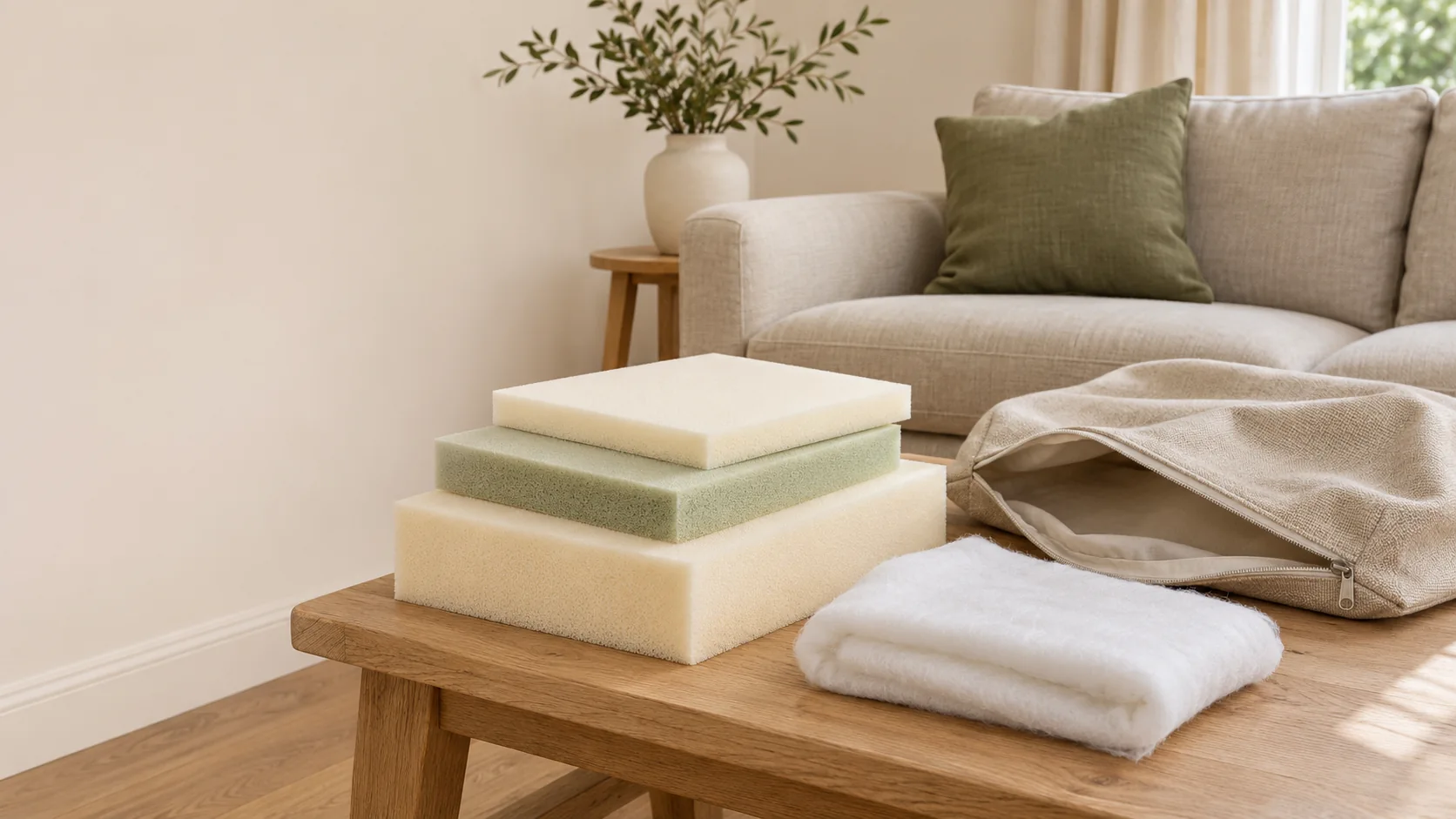
Check what is actually failing
Remove a loose cushion only as intended and inspect its cover, filling and the support beneath it. A flattened cushion and damaged decking can produce a similar feeling when you sit down. Replacing foam will not repair a loose frame or failed spring.
Use our sagging couch guide to separate the likely causes before ordering material. Photograph the original cushion arrangement so an upholsterer can see how it was built.
Separate density from firmness
The Polyurethane Foam Association's upholstery specification guide explains that density and firmness are distinct properties. Density describes mass for a given volume, while an indentation-force measure describes firmness under a test condition.
That means a dense foam can still have a softer feel. Ask for both specifications and their units rather than buying from high density or firm wording alone. Keep the information for each candidate together so the comparison is meaningful.
Match the foam to the complete cushion
Thickness, cushion shape, wrapping and the support below the seat affect the finished feel. A foam sample on a hard worktop cannot fully reproduce the same material inside your sofa.
Take the cover and construction details to an upholstery supplier where possible. Ask how any fiber wrap or layered filling should be included in the finished dimensions. Do not add thickness at random if the cover is already tightly fitted.
Measure before requesting a cut
Record the intended finished cushion shape, including curves or a T-shaped front. Ask the supplier how it wants measurements taken, since its cutting allowance and wrapping method may differ.
Avoid using a badly compressed old insert as the only pattern. Check the cover and original specifications if available. Request written dimensions and the foam grade before confirming a custom cut that may not be returnable.
Test the feel and plan reassembly
Ask for a suitable sample or a trial cushion if offered, and describe how you prefer to sit. A firmer surface is not automatically more supportive or comfortable for every person. Compare the replacement in the actual seating system where possible.
For fixed upholstery, complex layered cushions or an unidentified original filling, use an upholsterer. Keep care and replacement records with the sofa information so future work starts with a known specification.
Diagnose the cushion before replacing foam
Remove the insert if the cover is designed for it and measure the foam or filling at several points. Check whether the problem is compression, a stretched cover, broken support below the seat or a combination. A new foam block cannot fix a sagging spring deck. Polyurethane Foam Association guidance distinguishes foam properties, but a seller's exact density, firmness and suitability still need checking. Keep the old insert as a template until the replacement fits.
Separate firmness from density
Density relates to how much material is in a given volume; firmness is how the cushion feels under a specified compression. A high-density foam is not automatically hard, and a firm new insert may feel uncomfortable if the seat geometry is wrong. Ask a supplier for samples or a return arrangement. Consider whether a fibre wrap or down envelope changes the feel and finished dimensions. The cushion should support the intended users without making it difficult to stand.
Measure the complete cushion system
Record the cover's internal dimensions, insert thickness, shape, bevels and any wrap. A replacement that matches the flat length and width but is too thick can strain the zipper and seams. Check whether the cushion is reversible and whether the back uses a different filling from the seat. If the sofa is under warranty, ask the manufacturer about an original replacement first. A custom-cut insert can be useful, but it should not be specified from an online size label alone.
Test one seat before ordering the set
Fit one replacement and use it for a normal week if the supplier allows. Check comfort, cover tension and whether it sits level with the adjacent cushion. If the original support below it is uneven, stop before buying more foam. Keep measurements and supplier specifications so a later replacement can match. The best foam is a fit between the insert, cover, frame and user, not a single density number applied to every sofa.
Common questions
Is high-density foam always firm?
No. Density and firmness describe different properties. Ask the supplier for both values, along with thickness and the intended application, before deciding how the finished cushion is likely to feel.
Can I use mattress foam in a sofa?
Do not assume it suits the seat construction. Ask an upholstery supplier to confirm that the material works for the cushion's thickness, support and use. A familiar foam name does not establish compatibility.
Should I make replacement cushions thicker?
Not without checking the cover, seat height and construction. Extra thickness can prevent proper fitting or change the sitting position. Ask for a replacement specification based on the complete cushion rather than the old foam alone.
Will new foam fix every sagging sofa?
No. The frame, springs or support below the cushions may also be damaged. Identify the cause before buying foam, and repair the underlying structure where necessary before judging the replacement cushion.