Read the construction part by part
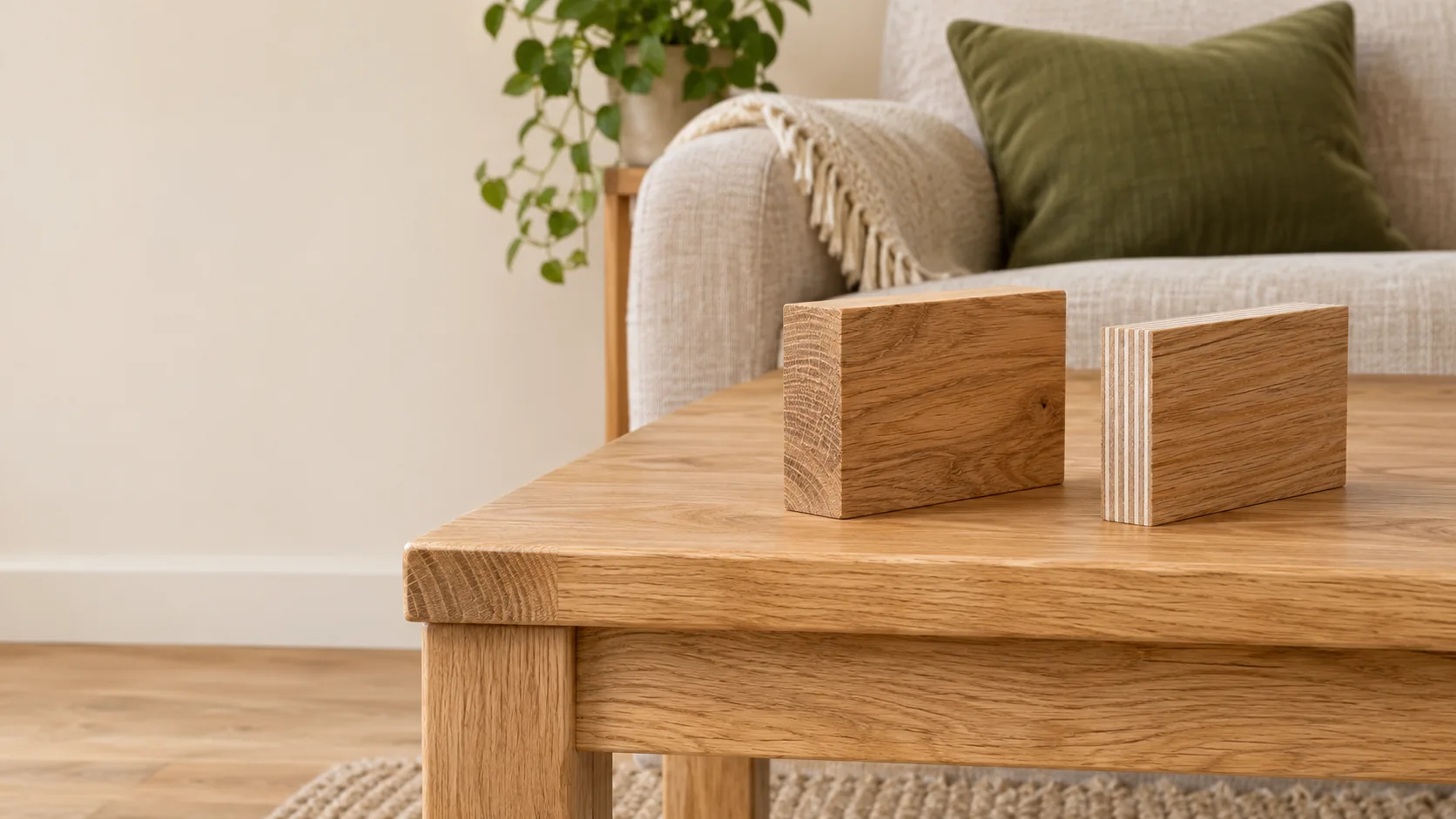
A table can have a veneered top and solid-wood legs, or different materials in its frame and storage base. Ask what the top, edges, underside and supports are made from. A wood species in the product name may refer only to the visible surface.
IKEA's table-material guide explains hardwood veneer as a wood layer over a supporting board. Its examples concern dining tables, but the distinction is also useful when reading a coffee table specification.
Inspect the finish and edges
Look at the edge treatment, joints and underside as well as the top. Ask whether the surface is oiled, lacquered or finished another way. The finish determines much of the permitted day-to-day care.
Do not identify the construction from a grain photograph alone. Edge banding and careful pattern matching can make a veneered part look continuous. Conversely, a solid-wood top may be assembled from several pieces rather than one slab.
Be realistic about repair
A thin veneer has limited material available for sanding. An aggressive attempt to remove a mark can expose the core. Solid wood may offer more scope for some repairs, but the finish, joinery and depth of damage still matter.
Ask the manufacturer what repair or refinishing it supports. Do not sand, bleach or strip a new table on the assumption that the material label makes the process safe. Professional assessment is sensible when the construction or finish is uncertain.
Choose the table for its actual use
Compare permitted loads, base stability, storage access and surface-care instructions. Protect the finish as directed and check whether heat or standing moisture can damage it. Neither construction removes the need for sensible use.
Our wood coffee table guide includes different constructions to inspect. If you are coordinating existing pieces, see mixing wood tones after you have resolved the material and maintenance questions.
Read each component separately
Solid wood describes the material through a piece; veneer is a thin wood surface over a core. A table can combine both. Ask what the top, legs, apron and shelf are made from, and whether the finish is lacquer, oil or another system. IKEA's material guide explains common constructions, but the exact table specification decides. Inspect edges and underside where a top's construction is easier to see. Do not treat veneer as automatically poor quality or solid wood as automatically trouble-free.
Choose for repair and daily care
Solid wood may permit more extensive refinishing, depending on thickness and finish, while a thin veneer has less material to sand. Both can mark with water or heat. Ask the maker how to clean and protect the surface, whether damage can be repaired and what humidity range it recommends. Check joint stability and whether the tabletop is flat. A well-made veneer table may suit a stable indoor room, while a solid-wood table may appeal to someone who expects future refinishing. Compare the whole construction and price.
Inspect the table in person where possible
Look for stable joints, a level top and sound edge banding. Run a hand gently along corners to check for roughness or a lifting veneer edge. Ask whether the legs can be removed for delivery and whether the finish is repairable. Check the table in the lighting it will face at home, because glossy surfaces show marks differently. A clear material description should be paired with sound construction; neither solid wood nor veneer can compensate for a wobbly base.
Common questions
Is veneer the same as laminate?
No. Wood veneer uses a layer of real wood. A laminate or printed wood-look surface has a different construction. Read the material specification rather than treating all wood-patterned surfaces as equivalent.
Can a veneer table be refinished?
Possibly, but the veneer thickness and finish limit the options. Ask the manufacturer or a qualified furniture restorer before sanding. Removing too much surface material can expose the core.
Does solid wood mean one piece of timber?
Not necessarily. A solid-wood component may be made from joined boards. Check the construction description if a single slab matters to you, and distinguish that preference from the general solid-wood category.
Is veneer just plastic?
No. Wood veneer is real wood in a thin layer over a core. Laminate and printed finishes are different materials. Ask for the exact construction of each table part.
Can I sand a veneer top?
Only within the material and finish limits, and aggressive sanding can cut through the veneer. Seek model-specific repair advice before trying it.
Will solid wood move with humidity?
Wood can expand or contract as conditions change. Follow the maker's indoor-use and care guidance. Construction and finish affect how visible that movement is.
Which is better for a busy family?
Compare finish durability, edge construction, repair options and cleaning instructions on exact models. Neither material label alone predicts how the table handles daily use.