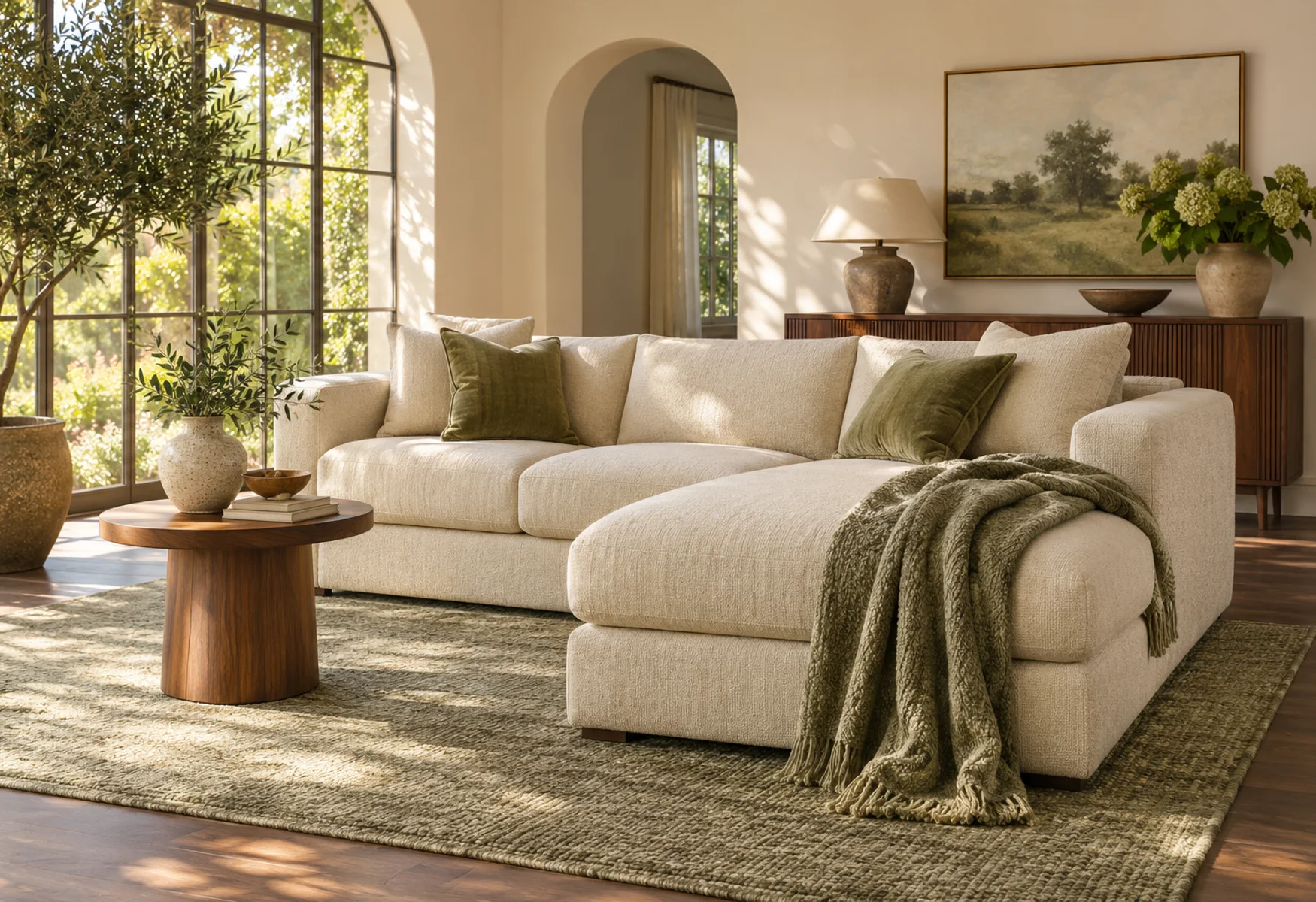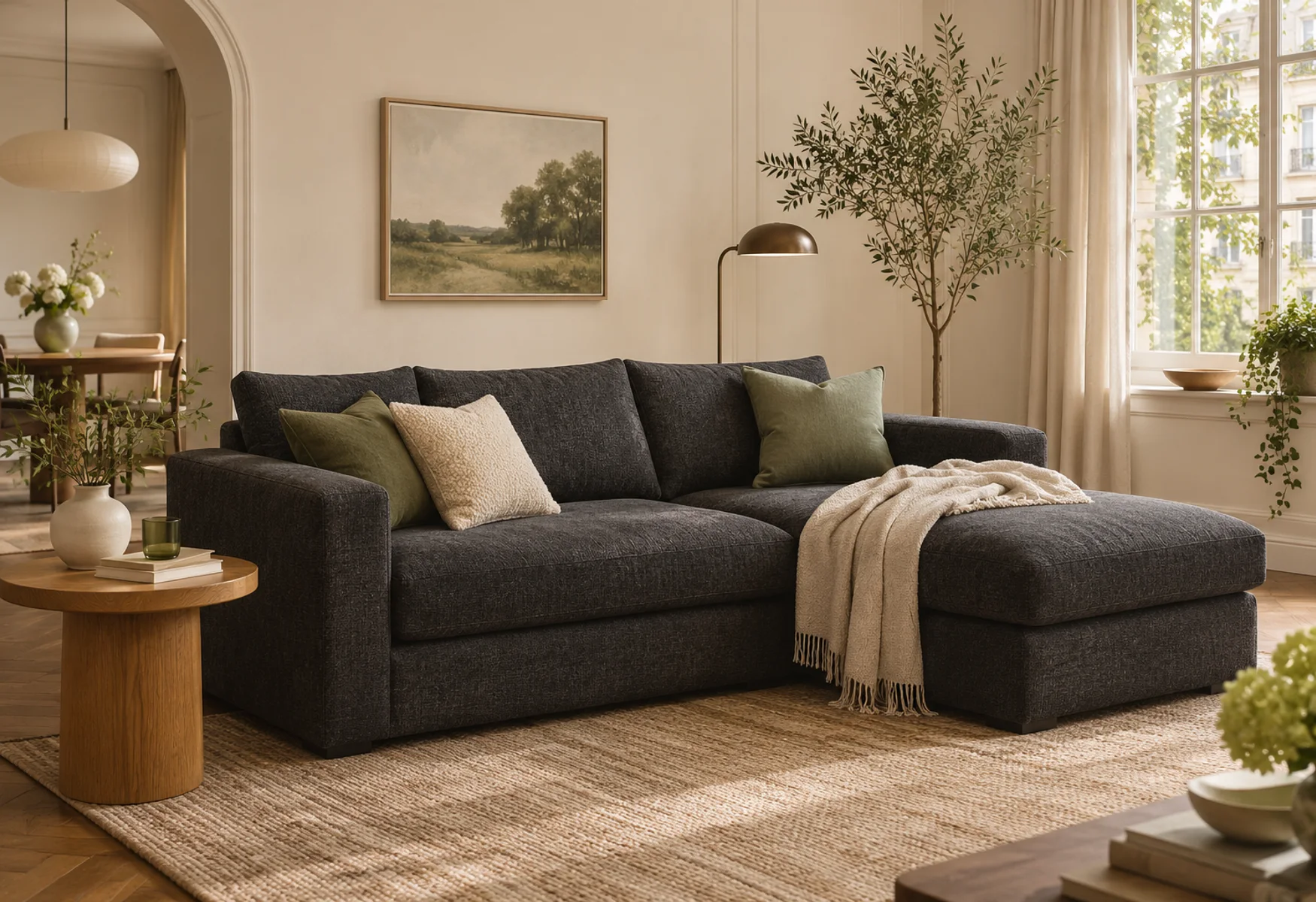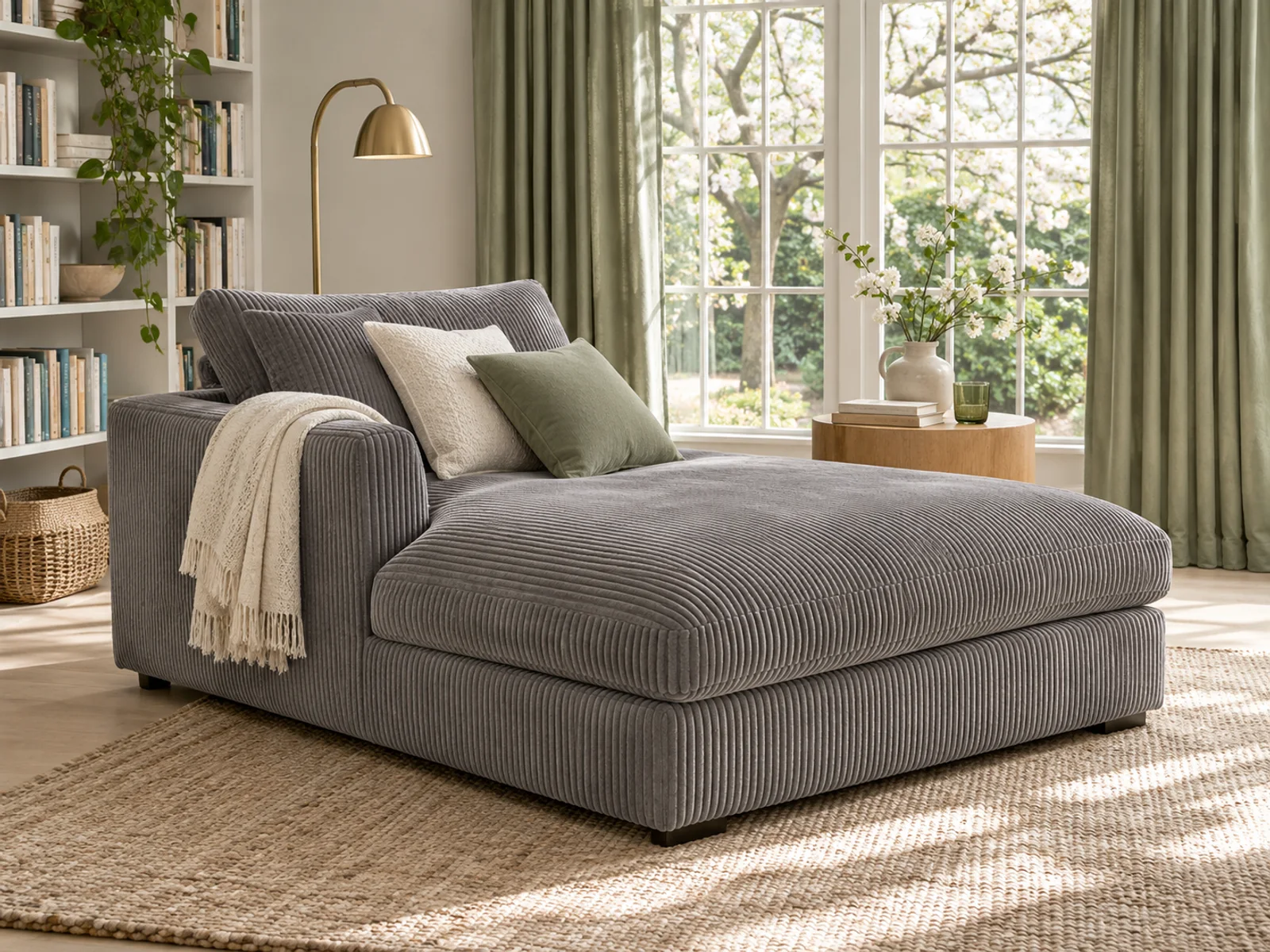
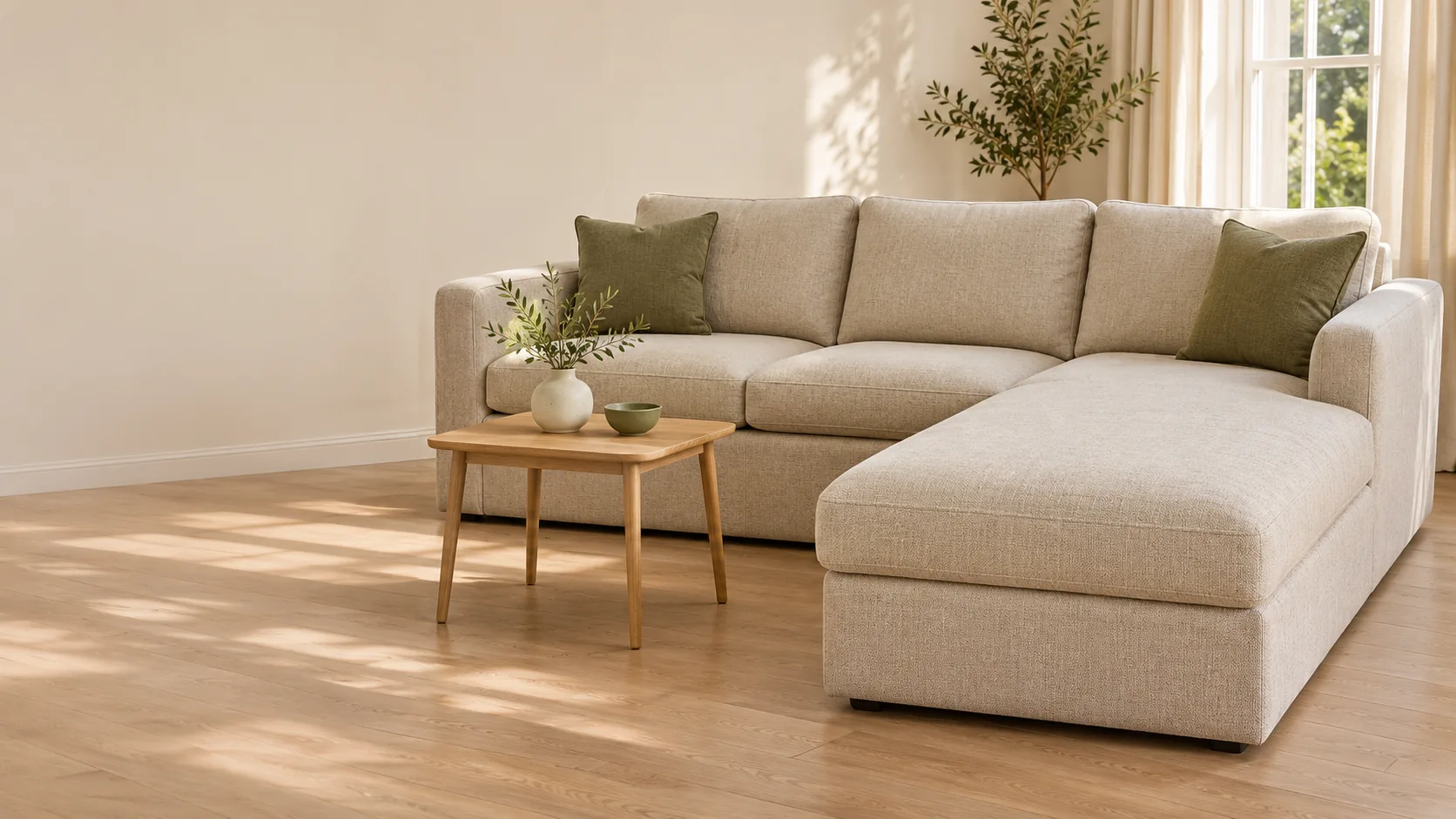
An extended seat within the sofa
The chaise creates a longer lounging position without necessarily adding a separate chair. It is different from a loose ottoman placed in front of a standard seat, although some designs use a movable footstool and long cushion to achieve a similar arrangement.
It can also be part of a larger sectional. The words chaise sofa describe the extended seat, not a guarantee of a particular number of sections, seats or storage compartments.
Confirm left and right with a drawing
Ask for a plan view showing the chaise position as you face the sofa. Retailer wording can be easy to misread, so match the image to your room rather than relying on a left or right label alone.
Mark the long projection on the floor. Check doors, a balcony route, nearby drawers and the path to the window. A chaise that fits the wall may still interrupt the route people use every day.
Check whether the layout can change
Some models allow the chaise to move from one end to the other. Others have a fixed shape or require different components. Get the exact configuration and assembly instructions before assuming a future room change will be easy.
Storage and sleeping features are separate checks. The IKEA FRIHETEN guide illustrates a sofa-bed design with chaise storage, but that combination should not be assumed for every chaise sofa.
Plan for the people using it
Think about who will usually take the extended seat. A long cushion can be appealing for one person stretching out, but the advertised seating count does not tell you how several people will share the sofa comfortably.
Test the regular seats as well as the chaise. Compare back support, cushion depth and the ease of standing up. Place a table where it remains reachable without making the walkway awkward.
Compare the full footprint
Our sofas with chaise guide gives you a place to compare configurations. Record overall width, regular depth, chaise depth and delivery dimensions separately.
If you want a lounging seat that can move independently, compare a standalone chaise lounge. It offers a different layout choice rather than being an automatic substitute for the same seating capacity.
Draw the chaise on the room plan
A chaise sofa extends one seat for legs, but descriptions of left and right can be viewed from different directions by different retailers. Use the seller's diagram and confirm the orientation in writing before ordering. Mark the full sofa and chaise footprint on the floor, then walk the room as usual. Check access to doors, drawers, radiators and the main path to the television. A chaise that projects into a narrow route can make an otherwise comfortable sofa inconvenient every day.
Test who uses the extended seat
Check whether the chaise is long and wide enough for the person who will use it most. Some designs have a separate ottoman or reversible cushion; others are fixed. Ask what can be moved or replaced later. Sit on the regular seats too, because a good chaise does not compensate for poor support elsewhere. If several people want to put their feet up, compare a sectional or separate ottoman. Consider whether a side table remains reachable without leaning across the extended cushion.
Check delivery and future flexibility
Measure each delivery section, not just the assembled width. Ask whether the chaise attaches with brackets and whether the modules can be separated for moving. Record the exact fabric, cushion construction and care instructions. If the room may change, a reversible or modular design could be worth considering, but verify the actual mechanism rather than relying on the word flexible in a listing. Keep the assembly drawing and model code for later replacement parts.
Write the orientation into the order
Before checkout, ask the seller to identify left or right facing from a specified viewpoint and include a diagram or model code in the order record. This matters because returns of large made-to-order furniture may be limited. Photograph the taped floor plan and compare the arm, chaise and entry path with the drawing. If the listing offers a reversible chaise, confirm which parts actually move and whether extra cushions or connectors are supplied. A clear record prevents a simple naming disagreement from becoming a delivery problem.
Common questions
Is a chaise sofa always a sectional?
No. A chaise can be integrated into a sofa or included as a component in a larger sectional. Check how the actual model is constructed rather than treating the two descriptions as identical.
Can the chaise switch sides?
Only when the particular design permits it. Some use a movable component and others are fixed. Confirm the exact model, parts and assembly instructions before choosing a layout that depends on reversibility.
Can two people sit on the chaise?
Do not infer capacity from the cushion length alone. Follow the seating arrangement and limits specified for the model. The extended area is generally intended to support a lounging position rather than create extra upright seats.
What is the most important measurement?
Chaise depth is easy to overlook because it extends beyond the regular sofa front. Record it alongside overall width and leave the walking space your room needs, then check the complete delivery route.