
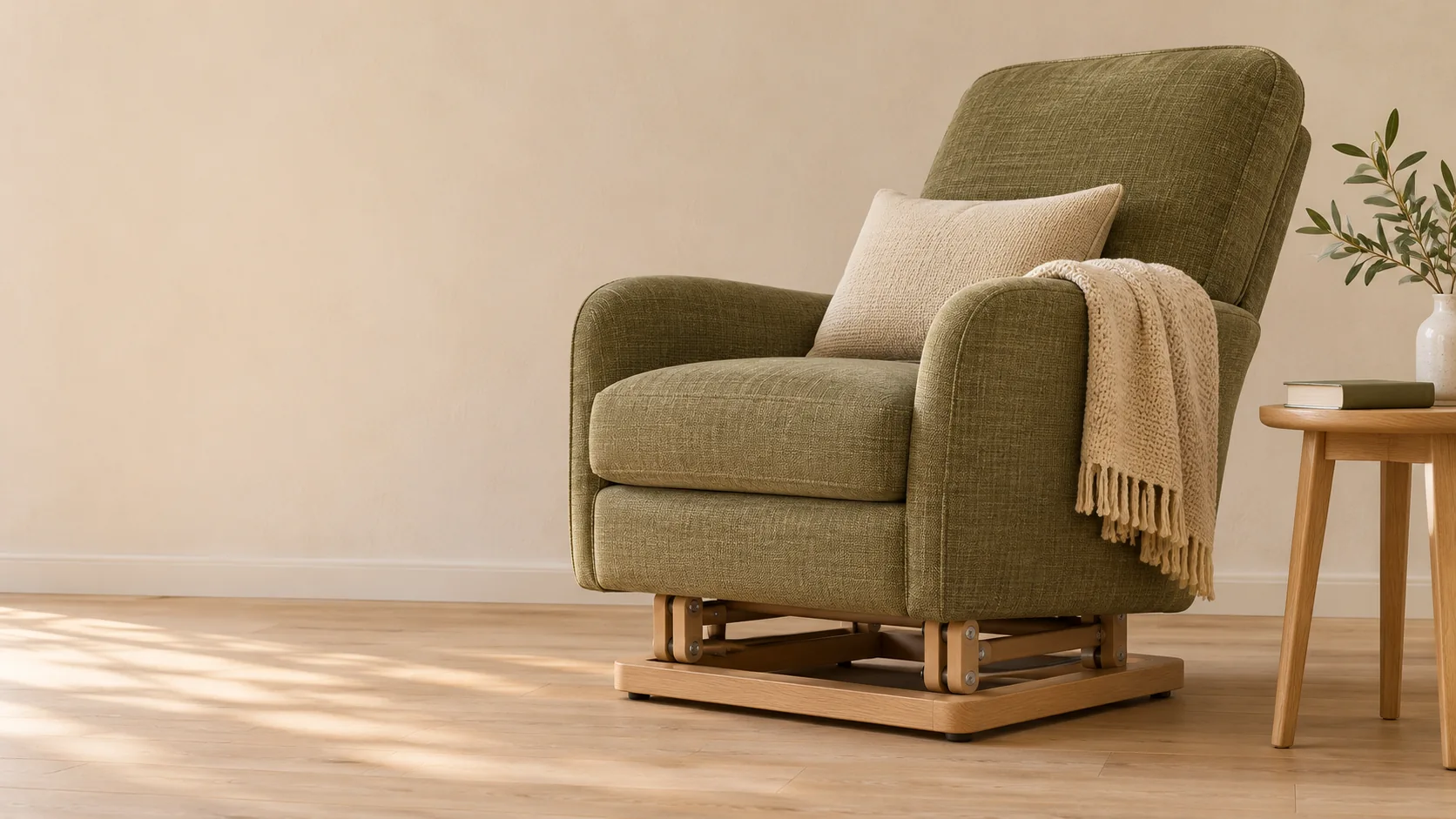
How gliding differs from rocking
A glider's seat moves relative to its stationary floor base. The mechanism guides the travel, while the base remains in its normal position. The exact arc and resistance vary between chairs.
A traditional rocker tips along curved runners. Both move, but they feel different and need different clearances. When trying either chair, pay attention to starting, stopping and standing up rather than judging only a few seconds of motion.
Read the full feature description
A swivel turns the chair. A reclining mechanism changes the back or footrest position. Power controls operate supported adjustments. A chair can combine these functions, but the word glider does not guarantee them.
La-Z-Boy supplies separate manuals for different glider configurations. Match the model number and controls to the exact instructions before comparing a manual chair with a powered alternative.
Measure the moving footprint
Mark the base outline, then add the manufacturer's required clearance for the back, arms and any footrest. Include the sweep of a swivel if present. A chair that fits while stationary may touch a wall or side table when it moves.
Use the specified level surface. Check whether a thick rug or raised rug edge could interfere with the base. Keep loose objects and cables clear of moving components, and preserve an open route for getting out.
Check fit from a seated position
Compare usable width, seat depth and arm height with a chair you already find comfortable. Sit back and check whether your feet reach the floor in the ordinary upright position. A smooth mechanism does not compensate for a seat that feels too deep.
Try reaching controls without twisting. If there is a motion lock, ask when it should be engaged. Follow the exact instructions for standing up, particularly where gliding and reclining interact.
Plan for everyday use
A reading corner needs a reachable light and somewhere for a drink, but those objects must remain outside the chair's travel. In a shared room, think about the person walking behind it as well as the person sitting down.
Keep fingers, children and pets away from moving parts. Follow the inspection instructions and stop using a chair that becomes unstable. Do not spray an arbitrary lubricant into an upholstered mechanism.
Our recliner-chair comparison helps separate reclining features from the motion you want. A glider is a movement choice, not a guarantee of fit or a therapeutic result.
Test the movement where the chair will live
A glider moves on a mechanism rather than pivoting through the arc of a traditional rocker. That makes the motion feel different, but it does not mean every glider is quiet or needs the same clearance. Measure the seat and the full movement envelope. Place painter's tape on the floor at the proposed footprint, including space behind the chair for its furthest position and beside it for a person to stand up. If the chair also reclines, test that as a separate motion. Read the exact model manual for pinch points and keep small hands away from moving parts.
Compare the whole chair, not just the glide
Sit in the chair for several minutes with your feet supported and your back against the cushion. Check whether the arm height suits reading, feeding or conversation, and whether the headrest forces your neck forward. A smooth mechanism does not compensate for a seat that is too deep. Ask how the upholstery is cleaned, whether the cushions can be replaced and how the mechanism is serviced. An upholstered glider can be a substantial purchase; record the full dimensions, delivery route and warranty terms before ordering.
Set up a safe daily routine
Keep cords, rugs and loose blankets away from the moving base. Check that the chair stays stable on the intended floor and that a nearby table remains reachable without leaning into the mechanism. If it is for a nursery, follow current safe-sleep guidance for the child; a comfortable chair is for supervised holding, not an infant sleep surface. Recheck fasteners and unusual noises as the manufacturer directs. A glider that begins to bind or tilt should be inspected before further use.
Ask what happens after the sale
Check whether the mechanism has replaceable parts and who provides service if it develops a squeak or uneven motion. Read the warranty for the frame, moving parts and upholstery separately. If the chair arrives in pieces, confirm the assembly steps and the tools required. Do not use it until all locking parts are fitted as directed. Keep the manual with the chair so later adjustments are based on its actual design, not a video for a different glider.
Common questions
Does every glider swivel?
No. Gliding and swiveling are separate movements. Check the exact model's features and manual. A similarly named version may use a different base, so confirm the selected configuration before planning its position.
Does a glider need space behind it?
Yes. Follow the manufacturer's clearance for the full travel of the back and any recline mechanism. A stationary floor base does not mean every moving part stays inside the closed footprint.
Can it sit on a rug?
Follow the chair's floor instructions and keep the base stable. A rug must not interfere with the mechanism. Avoid placing part of the base on a raised edge that leaves it uneven.
Is gliding more comfortable than rocking?
That depends on the seat and your preferred movement. Try starting and stopping both types, then compare sitting and standing. The motion category alone does not establish which chair will fit you better.