
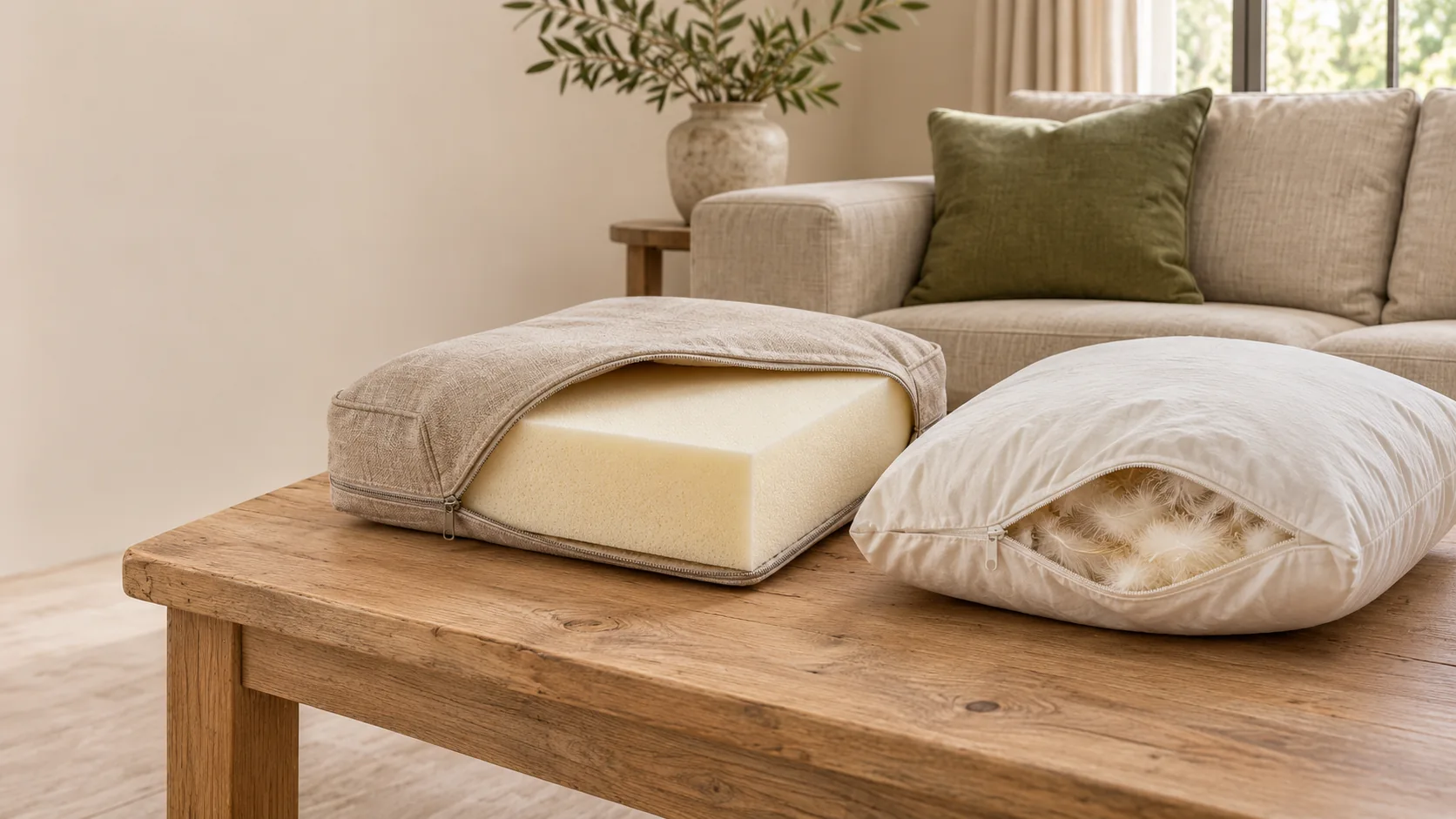
Find out what is inside each layer
Ask for the core, wrap and outer ticking materials separately. Seat and back cushions may use different fillings even on the same sofa. A short marketing label rarely describes the whole assembly.
Room & Board's comfort guide lists wrapped foam, blend-down and other constructions across its collections. Those examples show why foam and down are not always competing alternatives: they can be used together in one cushion.
Compare feel and recovery
Sit for long enough to move between your usual positions, then stand and observe the cushion. Notice how far you sink, whether the edge feels different and whether the surface needs reshaping. Treat the result as your experience of that sample rather than a prediction for every sofa with similar filling.
Do not equate foam density with a simple softness score. If the supplier provides technical figures, ask what each measures and how it relates to the complete cushion. Our sofa foam guide explores that specification in more detail.
Ask about regular upkeep
Some loosely filled cushions need frequent fluffing or redistribution to maintain their appearance. A structured foam core may involve a different routine, but all cushions still need the care specified by their maker.
Ask whether rotation is permitted, how often reshaping is recommended and whether the sofa in the showroom has just been dressed. If the filling contains animal-derived material, confirm its exact composition and any sourcing claims with the manufacturer.
Compare the whole sofa and replacement route
The support beneath the cushion, cover tension and seat dimensions also affect the result. Comparing filling labels on two very different frames can hide those differences. Try similar shapes where possible and record the precise specification.
Check whether replacement interiors are available and how a removable cover is refitted. Compare deep-seat couches only after deciding the feel and maintenance you want. A soft filling cannot compensate for a seat shape that does not suit you.
Read the whole cushion specification
Many cushions combine materials, such as a foam core with a feather or fibre wrap. Ask for the layer diagram, density or firmness information where available, and whether the insert can be replaced. Room & Board's comfort guide illustrates how construction affects feel, but the exact sofa must still be tested. A down label does not prove the seat is entirely filled with down, and a foam label does not tell you how supportive it will feel after use.
Match upkeep to the household
Down and feather wraps may need frequent plumping and can show impressions quickly; foam may return to shape more readily but vary widely in firmness and resilience. Sit on the sofa for a normal reading or conversation period, then stand and see how it recovers. Ask whether the covers can be removed and how spills are handled. If someone has an allergy or sensitivity, check the complete filling description. Comfort is a combination of seat depth, support and upholstery, not one material alone.
Ask for a care demonstration
Have the retailer show how to plump, rotate or flip the exact cushions and how long they take to recover after use. Ask what a normal impression looks like under the warranty. Keep a note of the layer construction and cleaning instructions so a later replacement can match. If the sofa is bought online, use the return window for a realistic seat test and photograph any uneven settling. The comfort choice should include the maintenance it requires.
Common questions
Is a down cushion made entirely from down?
Not necessarily. It may contain feathers, fiber, a foam core or several layers. Ask for the composition of the seat and back cushions separately, including any percentages the manufacturer publishes.
Does firmer foam always last longer?
Firmness alone does not establish lifespan. Foam specification, construction, support and use all contribute. Avoid choosing from a firmness description without the rest of the cushion information.
Can I change the filling after buying?
Sometimes, but confirm the cover access, intended dimensions and manufacturer guidance first. A different interior can alter the fit and feel. Obtain advice for the exact cushion rather than ordering by sofa width alone.
Can I replace down with foam later?
Possibly, but the cover dimensions and seat geometry need a suitable insert. Ask the manufacturer or a cushion specialist before ordering a generic block.
Does high-density foam feel hard?
Density and firmness are different properties. Ask for both specifications and test the actual cushion. A high-density foam can be made in different firmness levels.
Will a down wrap need daily care?
It may need regular plumping to distribute filling and restore shape. Ask the maker what routine it recommends and decide whether the household will keep it up.
What if one cushion sinks more than another?
Compare the insert and support under each seat. A filling change may not fix a damaged spring or webbing deck. Check warranty before altering the sofa.